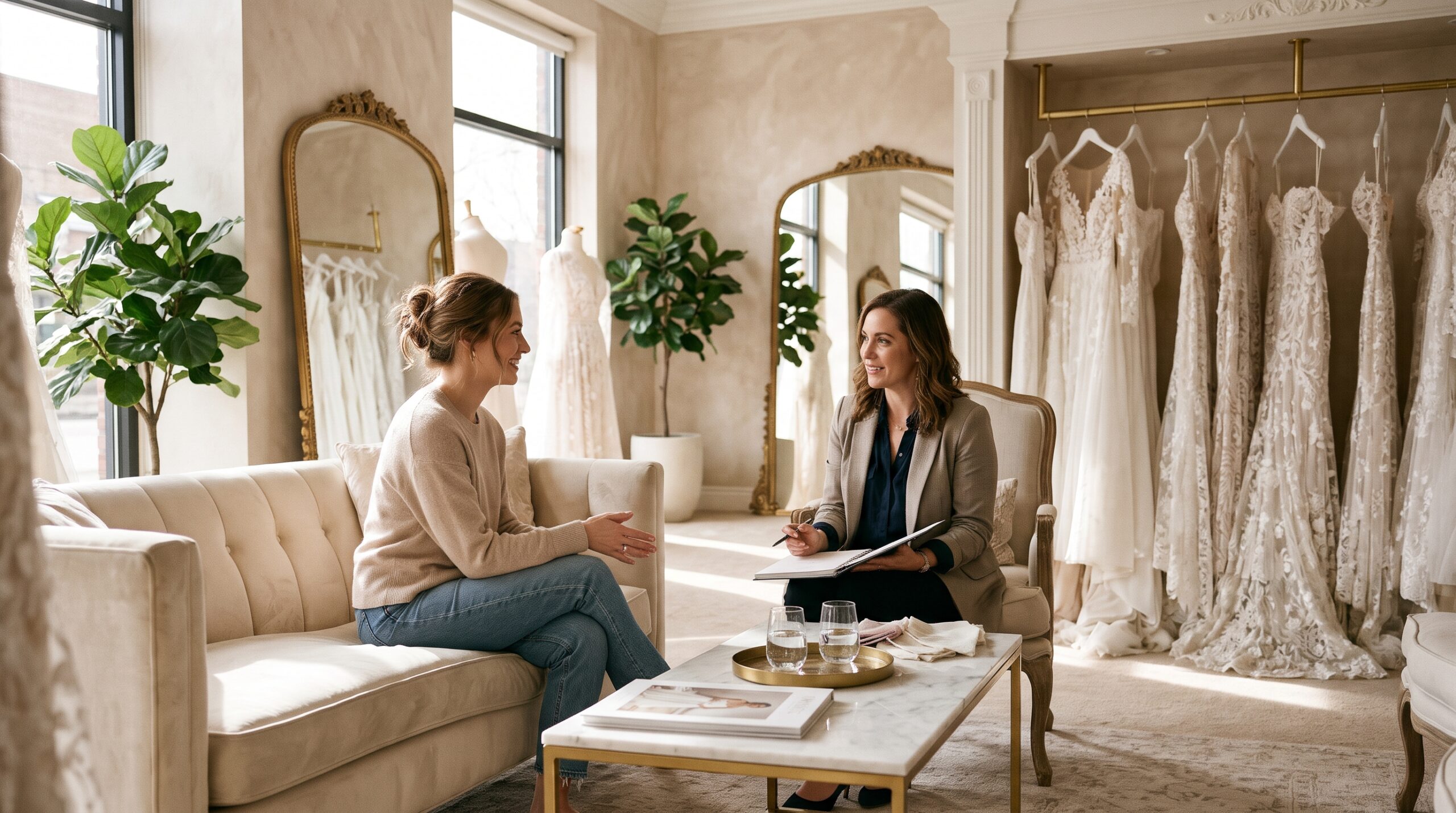
Wedding dress shopping questions to ask your consultant cover four areas: total cost including alterations, delivery timeline, what the listed price includes, and the boutique’s cancellation policy. Brides who skip these questions face an average of $400 in unexpected alteration fees and dresses that arrive after the wedding date allows for adjustments. This checklist walks through all 20 questions a certified bridal consultant expects a prepared bride to ask, organized by budget, timeline, fitting stage, and fabric.
Every bride who has said yes to a dress in the moment knows the feeling of excitement overriding the fine print. The purchase agreement gets signed, the deposit gets paid, and the real cost of the gown only becomes clear at the first fitting. This article gives readers a complete, printable set of questions to ask their bridal consultant before signing anything, along with the exact price ranges and timelines a boutique should confirm in writing.
Questions to Ask About Wedding Dress Budget and Cost
The dress price on the tag rarely reflects the final cost. Alterations, rush fees, and preservation typically add $300 to $1,200 to the original quote, depending on the gown’s construction and the bride’s timeline.
- Does the quoted price include the sample, or does made-to-order pricing apply? Sample gowns purchased off the rack carry no production wait time but arrive with visible wear. Made-to-order gowns take 4 to 6 months to produce and ship in unworn condition.
- What percentage deposit is due at signing? The bridal industry standard deposit is 50% of the total gown price, with the remaining balance due at the final fitting or pickup.
- Are alteration costs estimated in-house or referred to a third-party seamstress? In-house alteration quotes tend to run 10% to 15% lower than outside referrals because the boutique controls scheduling directly.
- Does a rush-order fee apply if the wedding date falls inside 6 months? Rush fees typically add $150 to $400 to the base gown price and compress the standard 4-to-6-month production window into 8 to 10 weeks.
- Does trunk show pricing differ from standard in-stock pricing? Trunk show gowns carry designer-set discounts of 10% to 15% off retail, available only during the 2-to-4-day event window.
Trunk Show vs. Sample Sale Pricing
Trunk shows and sample sales get confused often, but the pricing structures differ significantly. Trunk show gowns are ordered new at a discount, with the bride selecting size and color options for production. Sample sale dresses are floor models sold as-is, with no alterations built into the price and no guarantee of size availability.
A bride ordering from a trunk show pays a deposit against a full production run. A bride buying a sample sale dress pays the full price upfront and takes the gown home the same day, alterations excluded.
Questions to Ask About Dress Alteration Cost and Timeline
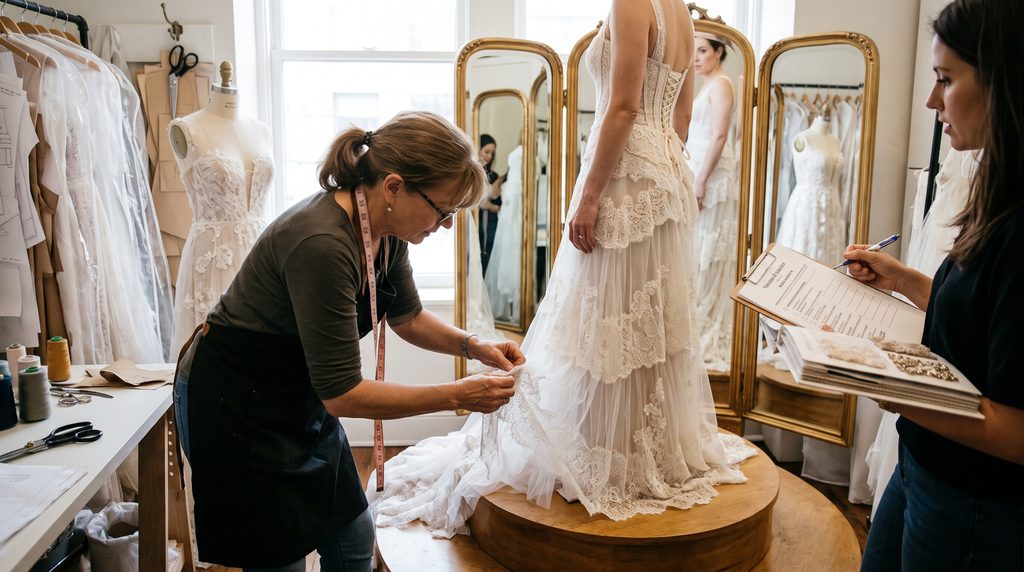
Alteration costs for a wedding gown run $150 to $800 depending on the changes required. A simple hem costs far less than adding a bustle or rebuilding a bodice.
- Can the boutique provide an itemized alteration quote? Hemming, bust adjustments, and bustling are priced as separate line items, not bundled into a flat rate.
- How many fittings are included in the base alteration fee? Three fittings is the industry standard: a first fitting for structural fit, a second for bustle and hem placement, and a final fitting to confirm zipper tension and range of movement.
- Does the boutique employ an in-house seamstress, or does it outsource alterations? In-house seamstresses typically turn fittings around in 2 to 3 weeks. Outsourced alterations can extend to 4 to 6 weeks depending on the seamstress’s booking calendar.
- What is the turnaround time between the first and final fitting? A standard alteration timeline spans 6 to 8 weeks from the first fitting to the final pickup.
- What happens if a weight change requires a mid-process resize? Most boutiques allow one complimentary resize within the alteration package; additional resizes are billed at $50 to $100 per adjustment.
What Happens at Each Fitting
The first fitting checks structural fit against the bride’s current measurements and flags where the bodice, waist, or hem need adjustment. The second fitting addresses the bustle construction and confirms the hem length against the bride’s wedding shoes. The final fitting confirms zipper tension, seam placement, and full range of movement, including arms raised and seated position.
At my own final fitting, the consultant caught a 1-inch gap at the zipper that the first two fittings missed. Correcting it took an extra 20 minutes on the spot, but it prevented the dress from gaping open during the reception. That single adjustment is the reason a final fitting exists as a mandatory step, not an optional one.
Questions to Ask About Wedding Dress Delivery and Ordering Timeline
Made-to-order wedding gowns take 4 to 6 months to produce from the date of order. Brides with a wedding date over 12 months away have the widest window to select fabric and customization options without paying a rush fee.
- Ask the exact production window the designer commits to in writing, not a verbal estimate.
- Ask whether a rush order is available and confirm the added cost before signing.
- Ask when the first fitting is scheduled relative to the gown’s arrival date.
- Ask what the boutique’s policy is if the gown arrives with a manufacturing defect or shipping damage.
- Ask whether a custom design request, such as added sleeves or a color change, extends the standard production timeline.
How Far in Advance to Order Your Dress
Brides with a wedding date more than 12 months out of order 9 months ahead of the ceremony to allow room for a design change or fabric backorder. Brides on a standard 9-to-12-month timeline order 6 months ahead at minimum. According to the Association of Bridal Consultants (ABC), a certified consultant confirms production and fitting timelines in writing at the time of purchase, not as a verbal estimate, to protect the bride against delivery disputes.
Questions to Ask About Fabric, Silhouette, and Sizing
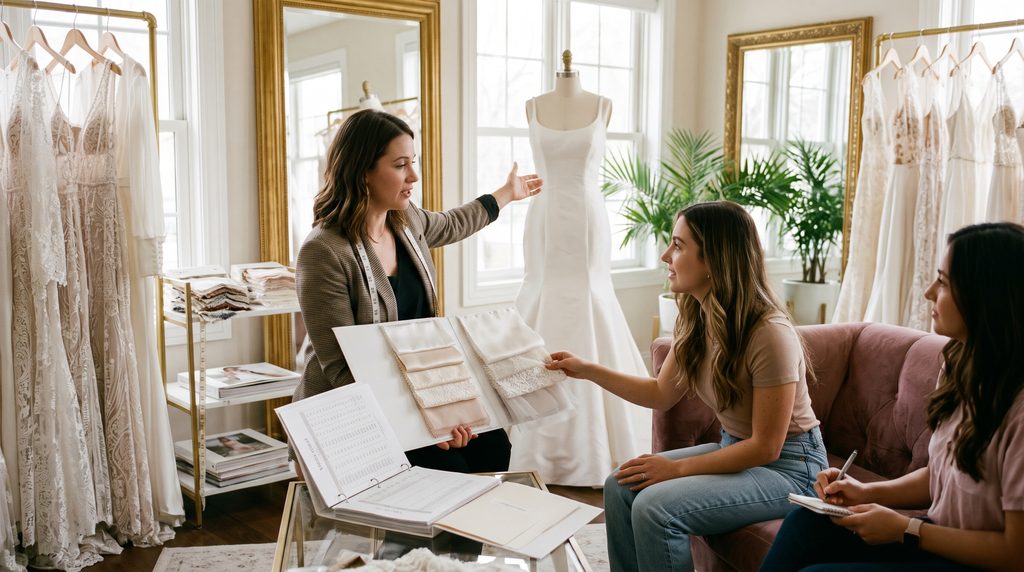
A common myth among first-time bridal shoppers holds that ordering a “regular” dress size in bridal will fit the same as ready-to-wear. Bridal sizing runs 1 to 2 sizes larger than standard retail sizing, meaning a bride who wears a size 8 in everyday clothing typically orders a bridal size 10 or 12 for the base measurement before alterations.
- Ask which fabric the sample gown is made from versus what fabric options apply to the order.
- Ask how the boutique’s bridal sizing chart compares to standard retail sizing before selecting an order size.
- Ask whether the silhouette can be modified after the order is placed; most structural changes, such as converting an A-line to a mermaid cut, are not possible post-order.
- Ask which fabrics show sweat marks or wrinkle under venue lighting and heat, particularly for outdoor ceremonies above 80°F.
- Confirm the exact bust, waist, and hip measurements the boutique uses to select the order size, rather than relying on a size label alone.
The myth that “your size” carries over from retail to bridal leads to gowns ordered too small, requiring costly let-out alterations that some fabrics, including heavily boned satin, cannot accommodate. A consultant who measures the bride directly and orders against those measurements, not a guessed size, prevents this outcome.
Questions to Ask About Dress Preservation and Care After the Wedding
Wedding dress preservation protects the fabric from yellowing and staining after the ceremony, but it does not guarantee permanent prevention of fabric aging.
- Ask whether the boutique offers preservation services directly or refers a third-party preservation company.
- Ask the cost range for professional preservation; the national average runs $150 to $350 depending on fabric type and embellishment.
- Ask the recommended window to begin preservation after the wedding; starting within 3 months reduces the risk of stains setting permanently into the fabric.
- Ask which preservation method the company uses, boxed or sealed, since sealed preservation prevents periodic inspection of the fabric.
Safety and accuracy note: Preservation reduces the rate of fabric yellowing and staining but does not eliminate it entirely. No preservation company can guarantee a gown will remain unchanged indefinitely, and any claim of permanent preservation should be treated as marketing language, not a verified outcome.
Questions to Ask Specifically for Plus-Size and Petite Brides
Sample gowns at most boutiques run in sizes 8 to 12, which leaves brides outside that range without an in-house sample to try on physically.
Brides who wear a size 14 or larger ask whether the boutique carries in-house plus-size samples or orders swatches and photos sight-unseen for a fitting appointment. Brides under 5’4″ ask about the standard hem allowance built into the base alteration package, since petite brides frequently require 3 to 6 inches removed from the hem alone. Both groups ask whether the boutique’s seamstress has fitted brides in their specific size range before, since bodice construction techniques differ between plus-size and standard-size garments.
Industry data shows a persistent gap in plus-size sample availability at bridal boutiques, which is why confirming in-house sample sizing before booking an appointment saves brides a wasted trip.
Frequently Asked Questions About Bridal Consultant Questions
How much do wedding dress alterations cost?
Wedding dress alteration costs range from $150 to $800 depending on the changes required. A basic hem costs the least, while bustle construction and bodice resizing cost the most. Regional pricing varies, so a written itemized quote from the boutique confirms the exact cost before the bride commits.
How far in advance should I order my wedding dress?
Ordering a wedding dress 6 to 9 months before the wedding date is standard for most made-to-order gowns. Brides with a wedding date under 6 months away pay a rush fee of $150 to $400 to compress the production timeline. Custom design requests extend the standard window further.
What should I ask my bridal consultant before buying?
Bridal consultant questions before buying cover four categories: total cost including alterations, the delivery and production timeline, exactly what the listed price includes, and the boutique’s return or cancellation policy. Confirming each category in writing prevents surprise costs after the purchase agreement is signed.
What is a trunk show and should I attend one?
A trunk show is a limited-time event where a designer’s full collection is available at a 10% to 15% discount off retail pricing. The trade-off is limited size availability during the 2-to-4-day event window, since not every sample size ships to every boutique.
How many fittings will I need before the wedding?
Three fittings is the standard process for a made-to-order wedding gown. The first fitting checks structural fit, the second addresses bustle and hem placement, and the final fitting confirms zipper tension and full range of movement 2 to 4 weeks before the wedding date.
Conclusion
The dress price on the tag is never the final cost. Alterations, rush fees, and preservation add $300 to $1,200 on average, and asking these 20 questions before signing surfaces every one of those costs upfront.
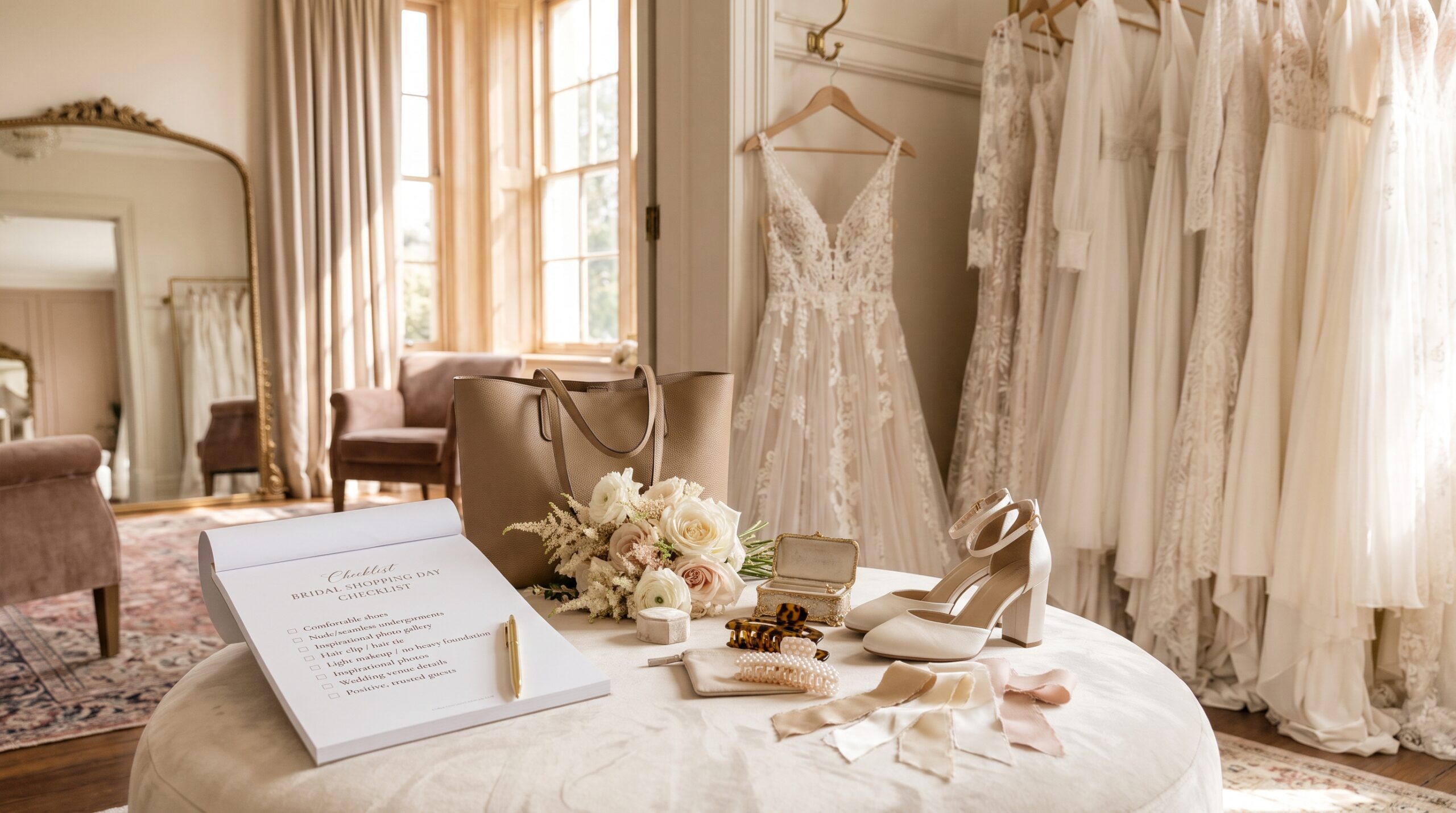
A bride who asks all 20 questions signs her purchase agreement with a fixed final number instead of a surprise invoice at the final fitting. The gown itself matters less than the clarity around cost, timeline, and sizing that these questions establish before any money changes hands. Download the printable 20-question checklist to bring to your next bridal appointment.