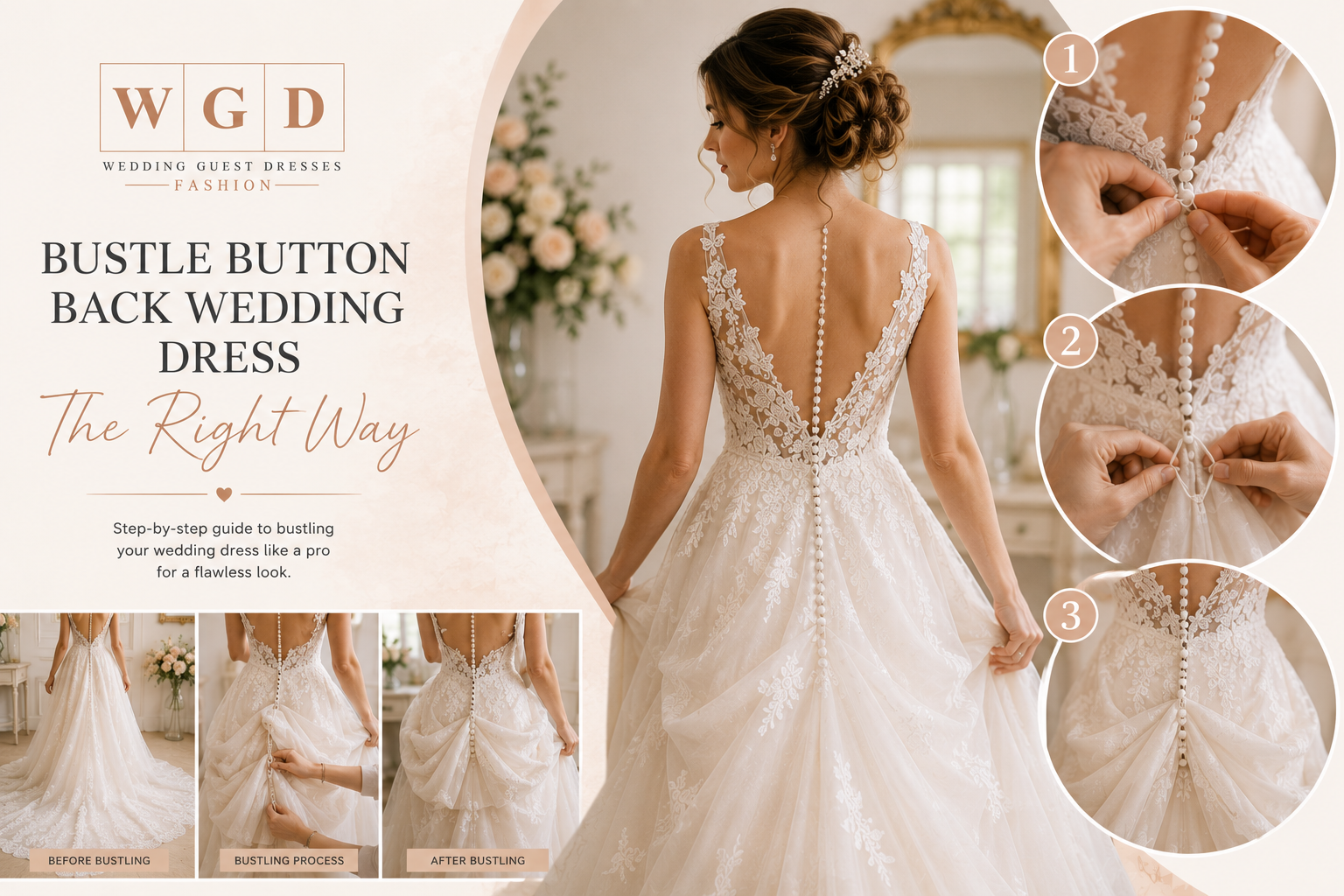
A button-back wedding dress creates a timeless, elegant look, but those beautiful buttons can make bustling the gown slightly more complicated after the ceremony. If you’re wondering how to bustle a wedding dress with buttons, the answer is usually a French bustle, also called an under-bustle.
Instead of pulling the train over the outside of the skirt, a French bustle tucks the train underneath the dress. This keeps the back buttons visible while helping protect them from the weight and tension created by the train.
Before your wedding day, it’s also helpful to understand how your dress silhouette, train length, and alterations affect the bustle. If you’re still choosing your gown, you can compare A-line vs. ballgown wedding dress styles to see how different silhouettes can affect the way a train behaves.
What Is a Dress Bustle and Why Do Button-Back Gowns Need a Different Approach?
A bustle is a system of interior hooks, loops, or ribbons designed to lift the wedding dress train off the ground after the ceremony.
Without a bustle, a long train can drag across the floor, become difficult to walk in, or get stepped on during the reception. A properly installed bustle transforms the gown from a ceremony-ready look into a reception-ready dress.
Button-back wedding dresses need special consideration because the buttons run down the exterior center back of the gown.
An American or over-bustle attaches the train to the outside of the skirt. On a button-back gown, that can cover the buttons and put additional stress on the button closures.
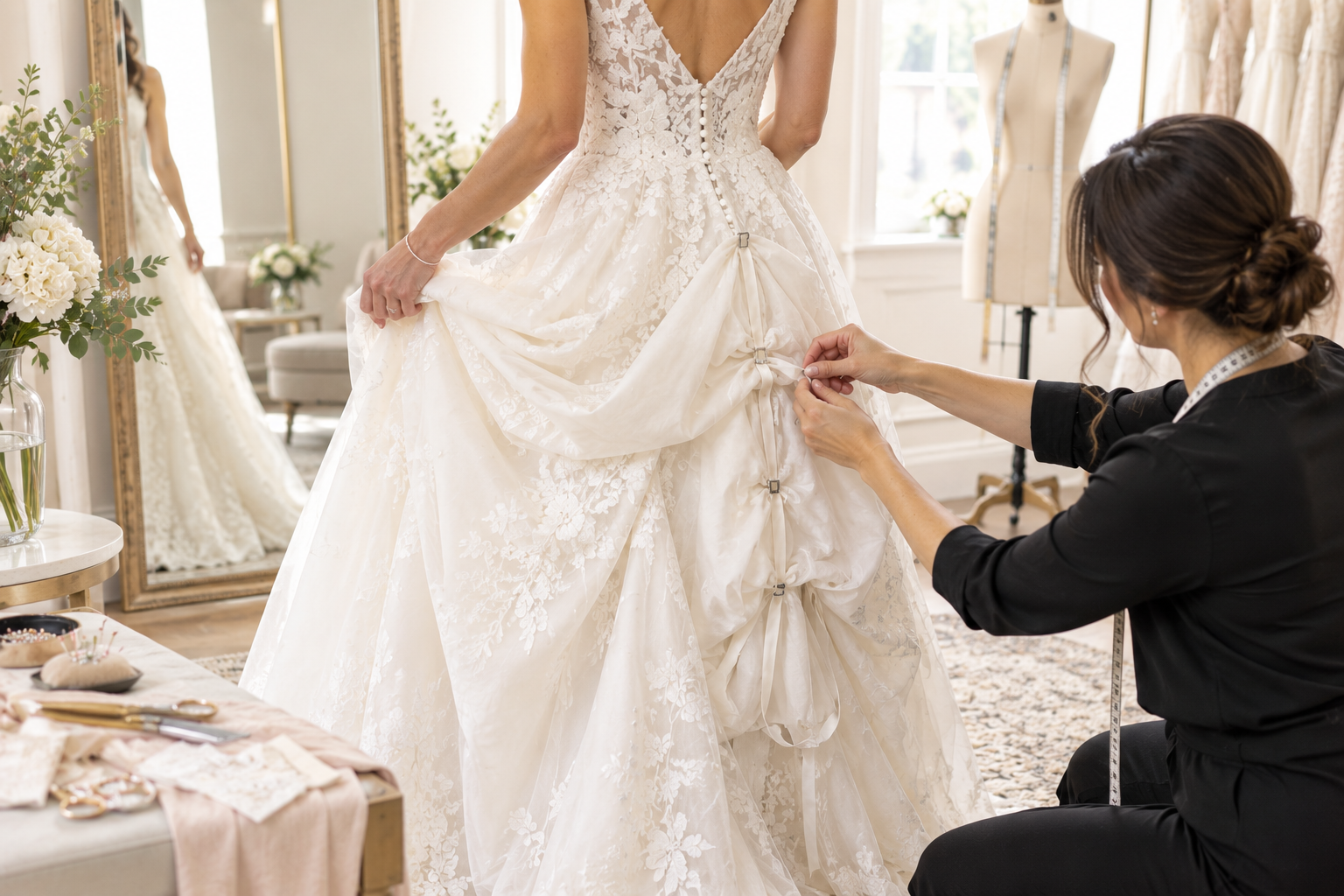
A French bustle takes the opposite approach. The train is pulled underneath the skirt using interior ribbons or attachment points. This preserves the exterior button line and creates a cleaner appearance.
If you’re planning alterations, it’s worth reviewing this wedding dress alterations cost guide before your final fitting so you know what bustle installation may involve.
Train Length and Silhouette Determine Bustle Complexity
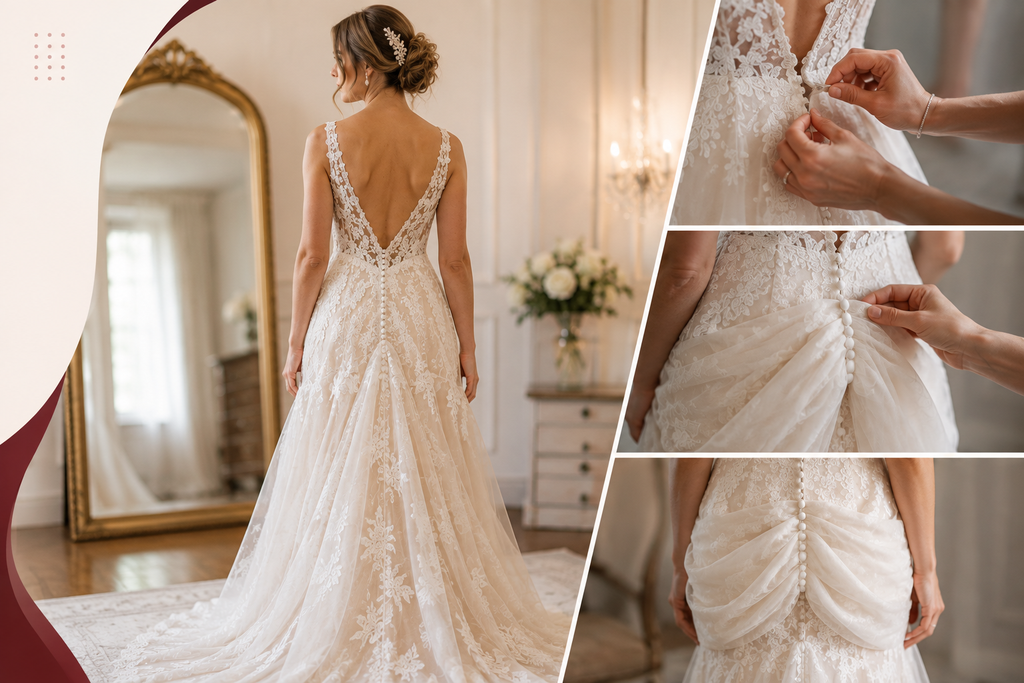
The length and weight of your train have a major effect on how many bustle points your dress needs.
- Cathedral trains: 7 to 9 bustle points
- Chapel trains: 5 to 7 points
- Sweep trains: 3 to 5 points
- Fit-and-flare gowns with long trains: often 6 to 8 points
- Mermaid silhouettes: commonly 5 to 7 points
Ball gowns with fuller skirts and longer trains generally require more attachment points to distribute the weight evenly. A-line dresses typically fall somewhere between simpler sheath-style gowns and very full ball gowns.
If you’re still deciding which silhouette suits you, read our guide to how to choose a wedding dress for your body type before making your final decision.
Plus-size brides may also want to consider how the gown’s construction, train weight, and proportions affect bustle placement. Our guide to plus-size wedding dresses that flatter provides additional guidance when comparing silhouettes.
Hook-and-Eye Closures vs. Ribbon Loops
Wedding dress bustles can use several different types of attachment systems.
Hook-and-eye closures provide a firm connection and can work particularly well with heavier fabrics such as satin or silk mikado.
Ribbon loops are easier to grasp with your fingers and are commonly used when a seamstress wants the bustle to be relatively simple to fasten. However, the ribbons need to be tied correctly to prevent the train from slipping.
The appropriate system depends on the construction and weight of the dress. Heavy beadwork, multiple layers, and long trains require especially careful anchor placement.
This is one reason professional alterations matter. The seamstress needs to consider the finished hem, fabric weight, lining, and distribution of the train before installing the bustle.
French Bustle vs. American Bustle
There are several bustle styles, but the two most commonly discussed are the American bustle and French bustle.
| Feature | American Bustle | French Bustle |
|---|---|---|
| Attachment location | Exterior skirt | Interior skirt |
| Button visibility | Usually hidden | Preserved |
| Best for | Many zip-back gowns | Button-back gowns |
| Appearance | Visible exterior draping | Train tucked underneath |
| Fastening | Hooks, buttons, or ties | Interior ribbons or hooks |
American Bustle
An American bustle, sometimes called an over-bustle, attaches the train to points on the outside of the skirt. The train folds upward and creates visible draping.
This can work beautifully on some gowns, particularly when the dress does not have a decorative button line that needs to remain visible.
French Bustle
A French bustle, or under-bustle, uses attachment points inside the skirt to pull the train underneath the gown.
For a button-back wedding dress, this is generally the preferred approach because the exterior buttons remain visible and the train doesn’t have to be pulled over them.
How to Bustle a Wedding Dress With Buttons
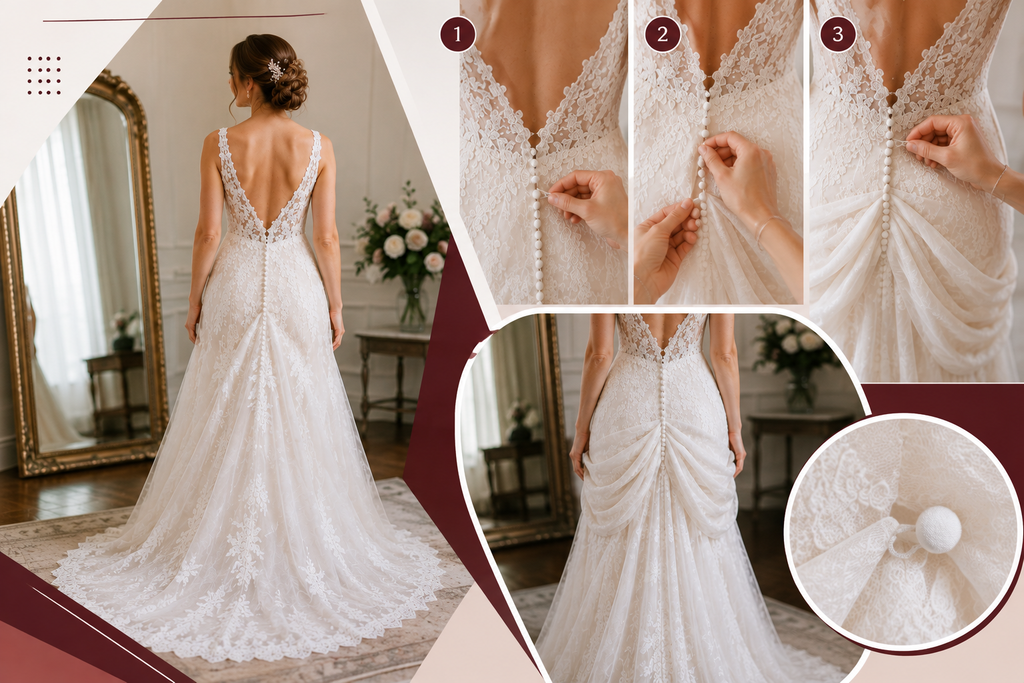
Once the bustle has been professionally installed and the ribbons or loops have been numbered, the actual process becomes much easier.
Step 1: Lay the Train Flat
Start with the train spread out behind the bride.
Locate the numbered ribbons, loops, or hooks inside the skirt. These points should have been installed and marked by the seamstress during alterations.
Step 2: Identify the Matching Anchor Points
Find the corresponding attachment points sewn into the waistline, lining, or interior structure of the gown.
The points should match the numbering system provided by the seamstress.
Step 3: Start With the Lowest Point
Fasten point number one first.
This is generally the lowest attachment point, closest to the hem. Pull the ribbon or loop upward and inward toward the center back.
Step 4: Continue in Numerical Order
Move from point 2 to point 3 and continue upward.
Do not randomly select the ribbons. The numbered sequence is designed to distribute the weight of the train correctly.
Skipping a point can create uneven tension, puckering, or an uneven hemline.
Step 5: Tuck and Adjust the Train
Once the attachment points are fastened, gently arrange the fabric underneath the skirt.
The folds should be distributed evenly rather than pulled sharply toward one location.
The exterior buttons should remain centered and visible.
Step 6: Check the Hemline
Walk around the bride and inspect the entire hem.
Make sure:
- The train is completely lifted off the floor.
- No ribbon tails are hanging below the skirt.
- The hemline looks even.
- The buttons remain visible.
- No part of the bustle is pulling excessively on the fabric.
If anything looks uneven, stop and check the attachment points rather than pulling harder.
How to Tie a Bustle Ribbon Loop
If your dress uses ribbon loops, the seamstress should demonstrate exactly how they are intended to be secured.
In many designs, the ribbon ends are crossed and tied using either a simple bow or a square knot.
After tying the ribbon, tuck the excess ends into the lining so they don’t hang beneath the dress.
Don’t automatically double-knot every ribbon. Follow the instructions provided by the seamstress because different bustle systems use different attachment methods.
How Long Does Bustling a Wedding Dress Take?
Your first attempt may take considerably longer than the actual wedding-day process.
During the final fitting, allow approximately 8 to 12 minutes for a first practice attempt. With repeated practice, the person responsible for the bustle should be able to complete the process in approximately 3 to 5 minutes.
The goal isn’t simply speed. The person bustling the dress should know exactly where each ribbon or hook is located and understand the correct sequence.
For this reason, your final fitting should include hands-on practice rather than just a verbal explanation.
Final Dress Fitting and Pre-Wedding Practice
A successful bustle depends heavily on preparation.
Ideally, schedule the final fitting 2 to 4 weeks before the wedding so there is enough time to address any last-minute adjustments.
Bring the two people who will be responsible for bustling the dress on the wedding day. The maid of honor can be the primary person, while one bridesmaid acts as the backup.
During the fitting:
- Have the seamstress demonstrate the entire bustle.
- Record a video of the demonstration.
- Have the designated bridesmaids perform the bustle themselves.
- Practice the process at least three times.
- Ask for a written diagram showing the numbered points.
- Keep the video and instructions accessible on the wedding day.
If you’re still planning your dress-shopping schedule, our wedding dress shopping timeline and checklist can help you plan appointments and fittings well in advance.
It’s also useful to understand wedding dress shopping etiquette for bridesmaids, especially if several members of your bridal party will be involved in the dress process.
Who Should Bustle the Wedding Dress?
The maid of honor is often the most practical choice because she is usually close to the bride throughout the wedding day.
One bridesmaid should serve as a backup.
Even if you have a large bridal party, it’s better to designate only two people for the job. Too many people trying to figure out the bustle at the same time can create confusion.
Both people should attend the final fitting and practice the complete process.
Record a Video of the Bustle Demonstration
A short video can be one of the most useful wedding-day references.
Ask someone to record the seamstress’s hands from behind the bride while she demonstrates the bustle.
Try to capture:
- Where each ribbon begins
- Where each attachment point is located
- The order in which the points are fastened
- How the ribbons should be tied
- How the finished train should look
This is particularly useful when the bustle needs to be completed in a dim venue bathroom or another unfamiliar location.
How Much Does It Cost to Bustle a Wedding Dress?
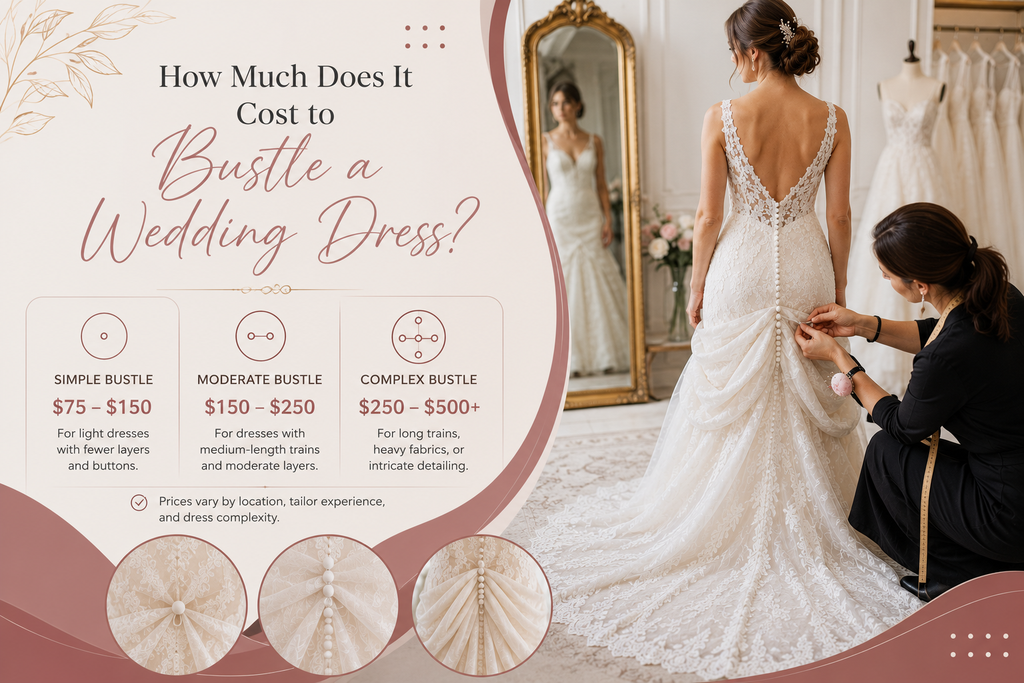
Bustle installation commonly costs between $75 and $250, depending on the dress, number of bustle points, fabric, construction, and location.
French bustles for button-back gowns may average approximately $125 to $200 because of the additional interior work involved.
Complex gowns can cost more. For example, a heavily beaded ball gown requiring numerous attachment points may require significantly more labor than a simple A-line gown.
Before approving the work, ask the seamstress for an itemized estimate covering:
- Bustle labor
- Ribbon or hook materials
- Number of attachment points
- Fitting time
- Any additional alterations
For a broader overview of alteration expenses, see our wedding dress alterations cost guide.
Bustle Cost by Dress Complexity
Approximate examples include:
- Simple A-line with 3 points: $75 to $125
- Beaded ball gown with 9 points: $200 to $350
- Button-back mermaid with 5 points: $125 to $225
These figures are provided as general market averages rather than guaranteed prices. Your seamstress may charge more or less depending on location and dress construction.
When Should You Bustle the Wedding Dress?
Most brides bustle the gown after the ceremony and before entering the reception.
Common opportunities include:
- After ceremony photographs
- During cocktail hour
- Before the grand entrance
- Immediately before the first dance
The important thing is to bustle the dress before guests begin walking around the bride and before dancing begins.
A long train left loose during the reception can become difficult to manage and may be stepped on.
Wedding Day Bustle Emergency Kit
Even a professionally installed bustle can occasionally experience a problem.
Prepare a small bridal emergency kit containing:
- Matching thread
- Small scissors
- Needle
- Two or three large safety pins
- Copy of the bustle instructions
- Bustle demonstration video on a phone
Assign one bridesmaid to carry the kit throughout the reception.
It’s also helpful to designate a specific bustle buddy who has practiced the process and knows where each attachment point is located.
What to Do If the Bustle Breaks
If a ribbon loop tears or an anchor becomes detached, don’t pull aggressively on the remaining attachment points.
Instead:
- Locate the damaged loop or anchor.
- Identify the nearest intact attachment point.
- Temporarily secure the train from the interior.
- Arrange the remaining train evenly.
- Contact the seamstress after the wedding for a permanent repair.
Safety pins should be used carefully and preferably from the interior lining outward so the metal does not rub against the bride’s skin.
Never push a safety pin directly through delicate beading or lace unless absolutely necessary, because doing so can damage the gown.
Bustle Before the Reception, Not Before the Ceremony
The train should generally remain extended for the ceremony and formal photographs if you want the full train visible.
After those photographs, have the designated bridesmaid or maid of honor bustle the gown before the bride enters the reception.
This allows the bride to move more easily while reducing the likelihood of guests stepping on the train.
Common Myths About Button-Back Wedding Dress Bustles
Myth 1: Any Wedding Dress Can Be Bustled
Not necessarily.
Very delicate lace, fragile appliques, vintage gowns, or dresses with particularly delicate construction may not tolerate repeated bustling.
A professional seamstress should evaluate the fabric and construction before deciding on the appropriate bustle.
Myth 2: An Over-Bustle Is Fine If You Are Careful
An over-bustle may not be appropriate for a button-back gown.
The exterior buttons can interfere with the way the train attaches and may experience additional stress.
A French bustle keeps the train underneath the skirt and preserves the button detail.
Myth 3: You Can Learn the Bustle Just by Reading Instructions
Written instructions are useful, but hands-on practice is better.
The person responsible for the bustle should practice during the final fitting and ideally repeat the process several times.
Myth 4: A Video Can Replace a Professional Seamstress
A video is an excellent reference tool, but it shouldn’t replace professional installation.
The seamstress determines where the attachment points should go based on the actual construction and weight of your gown.
Frequently Asked Questions
How do you bustle a wedding dress with buttons?
A button-back wedding dress generally uses a French or under-bustle. The person bustling the gown locates the numbered interior ribbons or loops, starts with the lowest point, and works upward in sequence to pull the train underneath the skirt.
How much does it cost to bustle a wedding dress?
Bustle installation commonly ranges from approximately $75 to $250, depending on the dress and number of bustle points. French bustles on button-back gowns may cost around $125 to $200.
What is the best bustle style for a button-back gown?
The French bustle, or under-bustle, is generally the best choice for a button-back gown because it keeps the train underneath the skirt and preserves the exterior buttons.
Who should bustle the dress on the wedding day?
The maid of honor is a practical primary choice, with one bridesmaid serving as backup. Both should attend the final fitting and practice the bustle before the wedding.
Can any wedding dress be bustled?
Most wedding dresses can be altered with an appropriate bustle, but particularly delicate lace, fragile appliques, and some vintage gowns may require special consideration. A professional seamstress should evaluate the dress before installing one.
Final Tips for a Stress-Free Wedding Dress Bustle
A button-back wedding dress doesn’t have to be difficult to manage at the reception. The key is preparation. Have a professional seamstress install the bustle, attend the final fitting with the two people who will handle it, practice the process at least three times, and record a video demonstration. Keep a written diagram and small emergency kit available on the wedding day.
Most importantly, don’t rush or pull forcefully if something doesn’t seem right. A properly installed French bustle should allow the train to be lifted securely while preserving the elegant button-back detail. If you’re still comparing wedding dresses, start with our guides to A-line vs. ballgown wedding dresses, wedding dresses for different body types, and affordable wedding dresses under $500. And once the wedding is over, don’t forget about wedding dress preservation after the wedding so your gown can be properly cared for long after the celebration.